Toy-scale prototype first
One propeller.
Steered at the rim.
A flying disc with a single propeller at its centre. Instead of tilting the whole body to turn, it redirects the propeller’s thrust around the rim through a ring of vanes. The disc stays flat while it lifts, hovers and moves sideways.
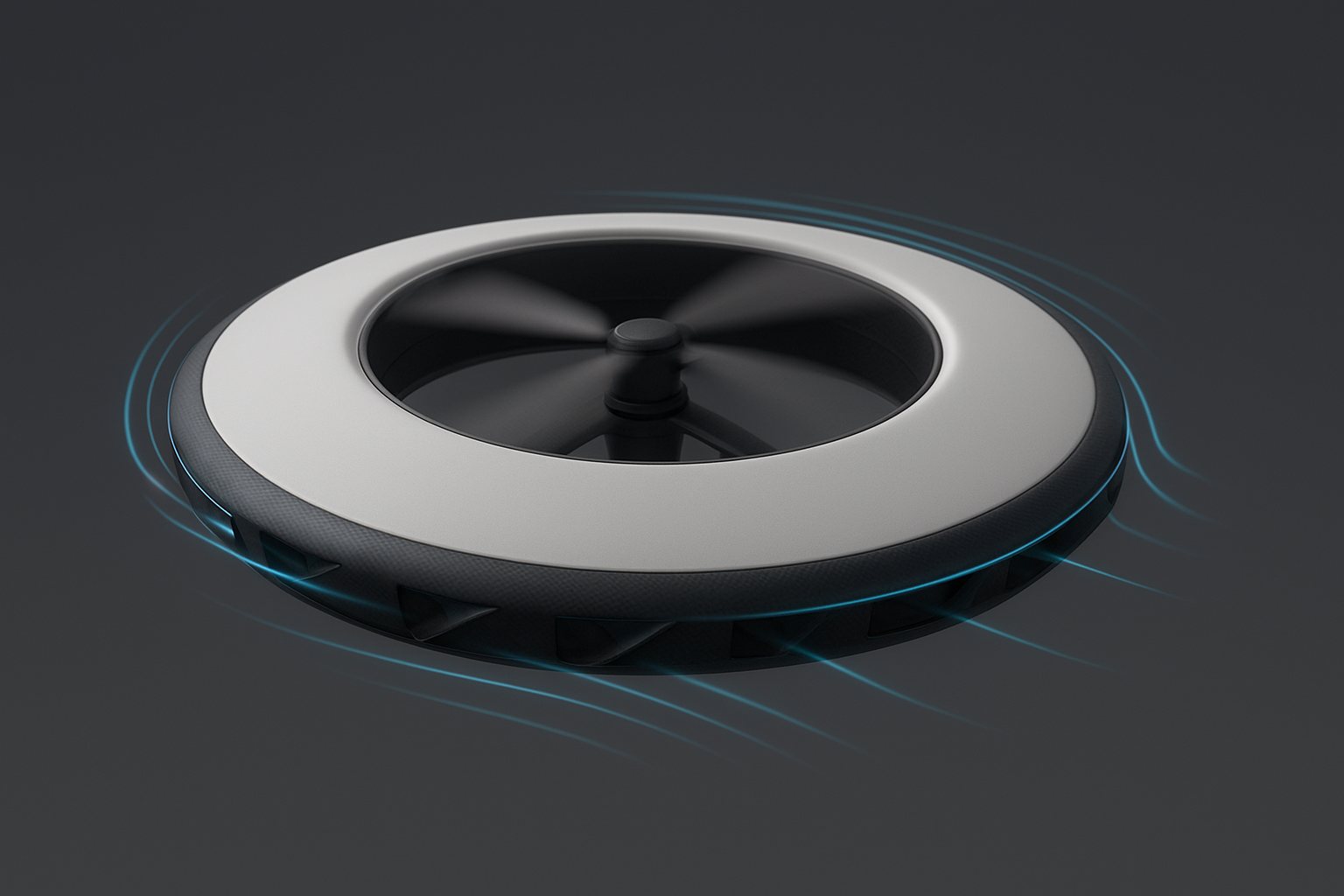
The long game. We start with a toy, because a small disc is where the control loop can be fast enough and cheap enough to prove the idea. If tangential control holds up there, the same principle — one rotor, thrust pushed around the rim — is our route toward a new class of personal transport.
What the disc is
A disc, a propeller, and a ring of vanes.
The body is a shallow circular duct. A single propeller spins inside it and pushes air downward — that is the only source of lift. Around the inside of the rim sits a ring of small vanes. Each vane can be angled to catch part of the downwash and throw it sideways, in the direction the pilot wants to go.
There is no second rotor, no swashplate and no tilting of the airframe. Lift comes from the propeller; direction comes from where the air leaves the rim.
Ducted single rotor
One motor, one propeller, mounted at the centre of the disc. The duct is the airframe.
Vane ring at the rim
Small controllable vanes redirect the airflow leaving the disc. Their angles are the steering.
Flat body
Steering does not depend on leaning the disc. The craft can translate while staying level.
Fast control loop
Cheap, fast motors and flight controllers are what make rim steering plausible at small scale.
Why it isn’t a quadcopter
A quadcopter changes rotor speed to steer. This disc changes where the air goes.
Both fly by pushing air downward. The difference is what the aircraft does with that thrust when it wants to move.
Quadcopter
Four rotors, tilting
- Four propellers, each with its own motor and speed controller.
- Steering is differential thrust: speed some rotors up and others down.
- To translate, it tilts its whole body, so thrust points partly sideways.
- Lift and control are coupled — every manoeuvre changes how much lift the rotors make.
Tangential disc
One rotor, redirected thrust
- One propeller at a roughly constant speed.
- Steering is tangential: vanes angle the downwash sideways around the rim.
- The body can stay flat while it lifts, hovers and translates.
- Control comes from the direction of the exhaust, not from changing rotor speed.
The trade-off, stated plainly: redirecting thrust costs energy, and holding a single-rotor disc steady is a harder control problem than balancing four rotors. Those are the questions the prototype is meant to answer — we are not claiming they are solved.
What we know vs. what we’re testing
Physics we can demonstrate, and physics still on the bench.
This is an early-stage concept. We keep the two categories apart on purpose: the left column is textbook behaviour you can watch in the demo; the right column is what we still have to earn.
- Thrust along the rotor axis. A spinning propeller accelerates air one way; the reaction pushes the disc the other way.
- Thrust is a vector. Angle a vane in the flow and part of the downwash leaves sideways, so the total force tilts.
- Sideways exhaust creates yaw. Air thrown around the rim produces a torque about the disc's centre — turning without leaning.
- Torque has to balance. The rotor's spin-up torque is countered by the vanes, so the disc doesn't simply spin with the propeller.
- Lift above weight rises; below, it sinks. Vertical motion follows from net vertical force — the demo lets you see the crossover.
- That it can be flown stably. Holding a single-rotor disc steady with rim vanes alone is an open control problem. No flight has been shown yet.
- How much efficiency redirection costs. Diverting thrust is not free. We have not measured the penalty against a tilting rotor.
- Whether it scales. Actuator speed, mass and heat in a larger vane ring are untested. The personal-transport idea depends on this.
- Carrying a person. Human flight is the long-term intent, not a current plan. There is no timetable, prototype or performance figure.
We publish numbers when we measure them. Nothing on this page is a performance claim or a flight result.
The interactive demo
Fly it yourself.
Raise propeller RPM, deflect the vanes and set the disc’s attitude, then watch it lift, hover and translate. Every behaviour it shows comes from the demonstrable physics above — the theory stays theory.
- Altitude
- 0.00 m
- Ground speed
- 0.00 m/s
- Yaw rate
- +0 °/s
- Thrust
- 0.0 N
- Spin rate
- 0 rad/s
- Cone half-angle β
- 0.0°
- Path curvature κ
- straight
Mass properties (added, standard rigid-body terms): m 0.175 kg, r 0.130 m, Izz 1.48e-3 kg·m², Ixx = Iyy 7.39e-4 kg·m². Thrust kT 3.0e-5, vane kv 0.12, prop reaction kQ 1.0e-5.
Lift, drag and the angle-of-attack coefficients are Morrison (2005), The Physics of Frisbees (Electronic Journal of Classical Mechanics and Relativity), with the paper’s constants and its Euler integration step at Δt = 1 ms. The inertia tensor, the Newton–Euler translation and rotation (including the gyroscopic term) and the cone and spiral read-outs are standard rigid-body mechanics we added — the paper names the moment of inertia only as future work. The thrust, vane and control-loop coefficients are illustrative and not measured from hardware, and the model has not been validated against a physical disc.